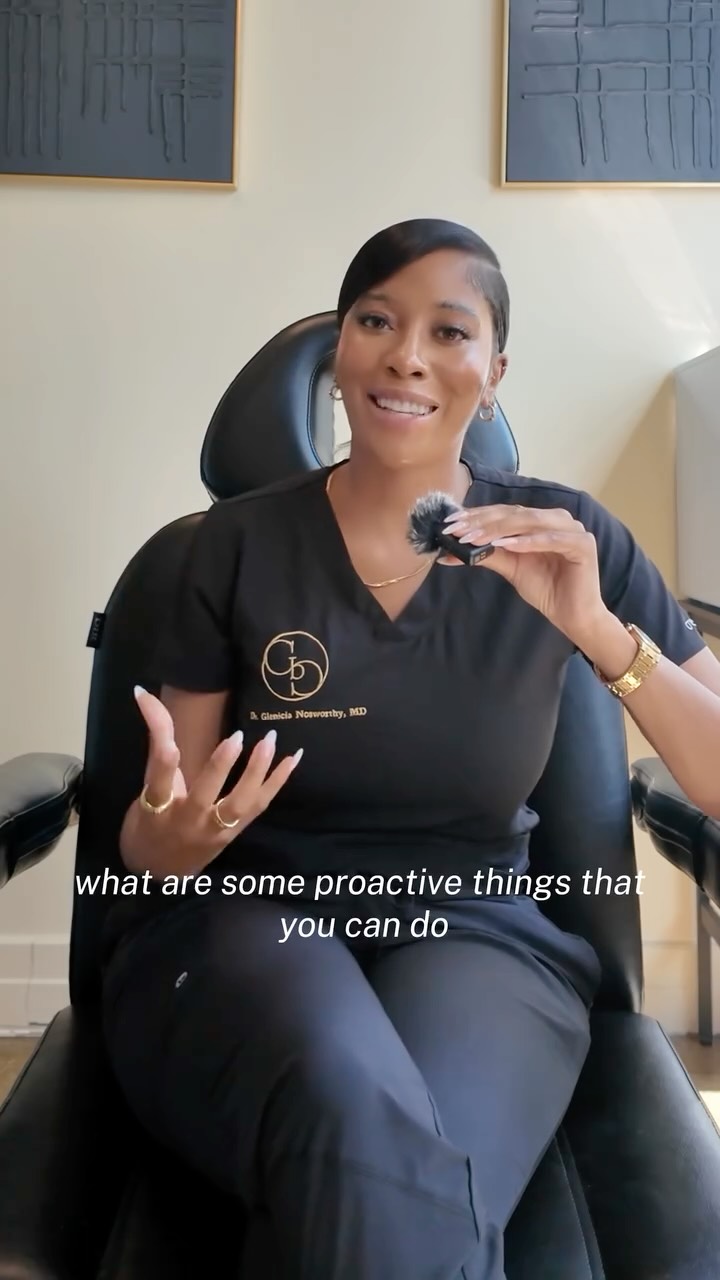
You do not need a new year to start optimizing your health
Dr. Glenda Nsofor breaks proactive skin health into three tiers you can start on today, not on January first.
GLO BY GLEN FACIAL OPTIMIZATION STAFFTurn your social into search
We turn your posts into editorial stories that bring new search traffic to globyglenmd.com. Three of yours will be on this page.
Book a demo
globyglen You don’t have to wait until January 1st to become more intentional about your health. If you’ve already decided you want to feel better, look better, and take better care of yourself, start now. From a Beauty Hacking™ perspective, being proactive means looking at your health from all three tiers. Internal Optimization Start with what you’re putting into your body every day. Can you reduce processed foods? Drink less alcohol? Improve hydration? Correct nutrient deficiencies? Add minerals and electrolytes to your water? Some of the most impactful changes don’t require a treatment at all. They require consistency. Procedures If your goal is to improve skin quality, texture, or laxity, regenerative and energy based treatments can be incorporated strategically before concerns become more advanced. External Optimization Your daily skincare routine is another investment you can begin immediately. One of my personal favorites is our L’Eclat Vitality Elixir, a 20% vitamin C formula packed with antioxidants like green tea polyphenols and ergothioneine to support brighter, healthier looking skin. The point isn’t to overhaul your entire life overnight. It’s to make one better decision, then another, and allow those decisions to become your lifestyle. Be proactive instead of reactive. You don’t need a new year to start loving on yourself. You can start today. 🤍 comment down below book to schedule your consultation
Dr. Glenda Nsofor breaks proactive skin health into three tiers you can start on today, not on January first.
GLO BY GLEN FACIAL OPTIMIZATION STAFFHow it works
Same as today. Nothing changes on Instagram.
We turn your post into a full story in your voice within the hour.
One click publishes it to globyglenmd.com. Nothing goes live without you.
Your stories
Nothing was published anywhere. You decide that. Every word will come from your own posts, your own photos and your own treatments.
Proactive Care · From your post
Dr. Glenda Nsofor breaks proactive skin health into three tiers you can start on today, not on January first.
“You don’t have to wait until January 1st to become more intentional about your health. If you’ve already decided you want to feel better, look better, and take better care of yourself, start now. From a Beauty Hacking™ perspective, being proactive means looking at your health from all three tiers. Internal Optimization Start with what you’re putting into your body every day. Can you reduce processed foods? Drink less alcohol? Improve hydration? Correct nutrient deficiencies? Add minerals and electrolytes to your water? Some of the most impactful changes don’t require a treatment at all. They require consistency. Procedures If your goal is to improve skin quality, texture, or laxity, regenerative and energy based treatments can be incorporated strategically before concerns become more advanced. External Optimization Your daily skincare routine is another investment you can begin immediately. One of my personal favorites is our L’Eclat Vitality Elixir, a 20% vitamin C formula packed with antioxidants like green tea polyphenols and ergothioneine to support brighter, healthier looking skin. The point isn’t to overhaul your entire life overnight. It’s to make one better decision, then another, and allow those decisions to become your lifestyle. Be proactive instead of reactive. You don’t need a new year to start loving on yourself. You can start today. 🤍 comment down below book to schedule your consultation”

Clinical Judgment · From your post
A Brooklyn injector explains why refusing to treat can be the safest option when something beneath the surface is not what it seems.
“Sometimes the best thing I can do for a patient is say no. I recently had a patient come to me after having her lips injected in a basement. Initially, they looked great. But over time, she began noticing lumps, bumps, and irregularities in the lip tissue. We attempted to dissolve the product, but it didn’t respond the way hyaluronic acid filler should. That raised an important concern. what was injected into her lips likely wasn’t hyaluronic acid at all, but a permanent foreign material such as a biopolymer or silicone. And this is where clinical judgment matters. Could I have added filler and temporarily masked some of the irregularities? Possibly. But that wouldn’t address the underlying problem. Instead, I referred her to a plastic surgeon to evaluate the foreign material for surgical removal. Once that is appropriately addressed and the tissue has healed, we can reassess whether filler is appropriate. Being a good injector isn’t just knowing when to inject. It’s knowing when not to. My responsibility is never simply to give a patient what they ask for. It’s to understand what’s happening beneath the surface and make the decision I believe is safest and most appropriate for them. Sometimes the treatment plan starts with saying no. 🤍 Consultation required. Individual results may vary.”

Regenerative Medicine · From your post
Safety in regenerative medicine starts long before a vial reaches the treatment room, and we treat sourcing as the first question, not the last.
“Are exosomes safe? Are stem cells safe? For me, the more important question is. where are they coming from, how are they processed, and who is overseeing their use? I’m extremely selective about the biologics I bring into my practice because if I’m willing to use something on myself or my family, I need to understand exactly how it was sourced, screened, processed, and handled. That means thoroughly vetting the companies I work with, understanding their donor criteria, reviewing their screening protocols, and making sure the products meet the standards required for the type of biologic being used. Donors are screened for factors such as infectious disease risk, substance use, and overall eligibility, and the donated tissue itself undergoes additional testing and quality control measures before it ever reaches my practice. That level of due diligence matters. Because when it comes to regenerative medicine, I don’t believe in blindly trusting a product simply because it’s labeled “stem cells” or “exosomes.” Safety starts with sourcing. Safety continues with screening. And safety ultimately depends on how thoughtfully the product is used. That’s the standard I use for my patients, myself, and the people I love.”
One social post becomes another searchable entry point to Glo by Glen Facial Optimization.
Our own magazine. Clicks and citations from Google Search Console, as of September 15, 2026.
Draft story for globyglenmd.com · Proactive Care
Dr. Glenda Nsofor breaks proactive skin health into three tiers you can start on today, not on January first.
A new year gets treated like a starting gun, as if health decisions only count once the calendar resets. We disagree. If you have already decided you want to feel better, look better, and take better care of yourself, the moment to begin is now, not some arbitrary date three months away. Intentional health does not wait for permission from a calendar.
From a Beauty Hacking perspective, being proactive means looking at your health across three tiers at once, rather than fixating on one fix and calling it a plan. Internal optimization, procedures, and external optimization each play a distinct role, and none of them requires you to overhaul your entire life overnight to matter.
Internal optimization begins with what you put into your body every day, and it is often the tier people underestimate. Reducing processed foods, drinking less alcohol, improving hydration, correcting nutrient deficiencies, and adding minerals or electrolytes to your water are all changes that cost nothing at a clinic. Consistency, not a procedure, is what makes them work.
Some of the most impactful changes we talk about with patients do not involve a single treatment at all. They require showing up for the same small decision day after day until it stops feeling like effort and starts feeling like how you naturally live. That shift is the actual goal, more than any single result.
Procedures have their place, but strategically, not as a first resort. If your goal is to improve skin quality, texture, or laxity, regenerative and energy based treatments can be incorporated before concerns become more advanced, which is a very different conversation than reaching for a procedure only after a concern has already taken hold.
External optimization is the tier most people already touch daily through their skincare routine, and it is an investment you can begin immediately. One of our own favorites is the L'Eclat Vitality Elixir, a 20 percent vitamin C formula built with antioxidants like green tea polyphenols and ergothioneine, formulated to support brighter, healthier looking skin over time.
The point was never to overhaul your entire life overnight. It is to make one better decision, then another, and let those small decisions accumulate into something that eventually looks like your lifestyle rather than a temporary push. Reactive care waits for a problem to appear. Proactive care simply does not leave that much room for waiting.
You do not need a new year, a birthday, or a milestone to start loving on yourself properly. The three tiers, internal, procedural, and external, are available to you today, in whatever order makes sense for where you are right now. If you are ready to talk through what proactive could look like for your skin, comment below to schedule your consultation.
Draft story for globyglenmd.com · Clinical Judgment
A Brooklyn injector explains why refusing to treat can be the safest option when something beneath the surface is not what it seems.
A patient recently came to us after having her lips injected in a basement. At first the results looked fine. Over time, lumps and irregularities developed in the tissue, and something about the way it was behaving did not sit right with what we typically see from hyaluronic acid filler that has simply settled or shifted under normal circumstances.
We attempted to dissolve the product using the standard approach for hyaluronic acid. It did not respond the way it should have. That reaction told us something important. Whatever had been placed in her lips likely was not hyaluronic acid at all, but something far less predictable such as a permanent biopolymer or silicone, materials that do not break down or reverse the way approved fillers do.
We could have added filler on top to smooth the irregularities and make the lips look better in the short term. That option existed. It would have been quick, and it likely would have satisfied the immediate request. But masking a problem is not the same as solving it, and covering foreign material does not change what is sitting in the tissue underneath it.
So we said no to that path. Instead, we referred her to a plastic surgeon who could properly evaluate the material and determine whether surgical removal was necessary. That is not a step we take lightly, and it is not one every provider is willing to take when a simpler, more profitable option is sitting right there in the room.
Being a skilled injector is not only about knowing how to place product well. It is about recognizing when the tissue in front of you is telling you something the patient cannot see for themselves. Our responsibility is not to give someone exactly what they ask for in the moment. It is to understand what is happening structurally before making any decision.
That means sometimes the most useful thing we can offer a patient is a referral instead of a treatment. Once the foreign material is appropriately addressed and the tissue has had time to heal, we can reassess together whether filler makes sense at that point. Rushing ahead without that step would only build a new problem on top of an unresolved one.
This case is a reminder of why where and by whom a procedure is performed matters as much as the procedure itself. Lip filler is common and generally straightforward, but complications become harder to manage when the original product is unknown. Judgment, not just technique, is what determines whether a patient walks away safer than when they arrived.
For us, a treatment plan does not always start with a needle. Sometimes it starts with a pause, an honest conversation, and a decision to protect the tissue first. Consultation is required for any treatment, and individual results always vary, but the starting point is always the same: understand what is really there before deciding what happens next.
Draft story for globyglenmd.com · Regenerative Medicine
Safety in regenerative medicine starts long before a vial reaches the treatment room, and we treat sourcing as the first question, not the last.
Are exosomes safe? Are stem cells safe? Those are the questions we hear most often, and they are fair ones to ask. But for us, the more useful question comes first: where did this material come from, how was it processed, and who is actually overseeing that process before it ever reaches a patient.
We are extremely selective about the biologics we bring into this practice. If we are willing to use something on ourselves or on our own families, we need to understand exactly how it was sourced, screened, processed, and handled. That standard does not change depending on who is sitting in the chair.
In practice, that means thoroughly vetting every company we work with before a single product enters our supply. We review donor criteria line by line. We ask how screening protocols are structured. We confirm that what we are being offered actually meets the standards required for that specific type of biologic, not just a general label.
Donors are screened for factors like infectious disease risk, substance use history, and overall eligibility, and that screening happens before the tissue is ever considered usable. From there, the donated tissue itself goes through additional testing and quality control measures. Only after clearing those steps does it reach our practice at all.
That level of due diligence matters because the regenerative medicine space moves fast, and language moves faster. We do not believe in blindly trusting a product simply because it is marketed as stem cells or exosomes. Those words describe a category, not a guarantee, and the difference between the two is where real safety lives.
Safety starts with sourcing: who the donors are, how they were screened, and what standards governed that screening. Safety continues with testing: what happens to the tissue after donation, and what quality control looks like before it is cleared for clinical use. Both steps happen well before a product is ever discussed with a patient.
And ultimately, safety depends on how thoughtfully the product is used once it is in a clinician's hands: the judgment applied to who is a candidate, how it is administered, and why. Sourcing and screening set the foundation, but application is where that foundation either holds or does not.
This is the standard we apply for our patients, for ourselves, and for the people we love, because in regenerative medicine, the question is never just what something is called. It is where it came from, who checked it, and whether that scrutiny was thorough enough to trust with someone's face.
Keep reading