How active lifestyles are changing plastic surgery planning
Surgeons Kelly Kileen, MD, and Tommaso Addona, MD, explain why returning to exercise is becoming part of the surgical conversation itself.
PLASTIC SURGERY STAFFTurn your social into search
We turn your posts into editorial stories that bring new search traffic to plasticsurgery.org. Three of yours will be on this page.
Book a demo
plasticsurgeryasps Missed this week's biggest moments in beauty and aesthetics? 👀 Here are the top three things you'll want to know about. 1️⃣ How fitness is shaping plastic surgery planning 2️⃣ What procedures are safe for a post pregnancy glow 3️⃣ The truth about plastic surgery scars Swipe left to catch up, and click the link in our bio to read more!
Surgeons Kelly Kileen, MD, and Tommaso Addona, MD, explain why returning to exercise is becoming part of the surgical conversation itself.
PLASTIC SURGERY STAFFHow it works
Same as today. Nothing changes on Instagram.
We turn your post into a full story in your voice within the hour.
One click publishes it to plasticsurgery.org. Nothing goes live without you.
Your stories
Nothing was published anywhere. You decide that. Every word will come from your own posts, your own photos and your own treatments.
Surgery & Fitness · From your post
Surgeons Kelly Kileen, MD, and Tommaso Addona, MD, explain why returning to exercise is becoming part of the surgical conversation itself.
“Missed this week's biggest moments in beauty and aesthetics? 👀 Here are the top three things you'll want to know about. 1️⃣ How fitness is shaping plastic surgery planning 2️⃣ What procedures are safe for a post pregnancy glow 3️⃣ The truth about plastic surgery scars Swipe left to catch up, and click the link in our bio to read more!”

Postpartum Care · From your post
Before restarting any treatment after having a baby, here is what deserves patience and what your body may be ready for.
“You deserve a little self care after having a baby. But before jumping back into your aesthetic routine, swipe left to learn what may be appropriate postpartum and what should wait. Always consult with an ASPS Member Surgeon to determine what's right for you, and save this post to reference later!”

2025 trends · From your post
New annual data breaks down which procedures actually trended with each group last year.
“The 2025 plastic surgery data is in 👏, but how did women and men show up last year when it came to procedures? 📝 Swipe left to see which procedures were the top ones for each! 🔗 For the full 2025 ASPS Plastic Surgery Statistics Report, click the link in our bio.”
One social post becomes another searchable entry point to Plastic Surgery.
Our own magazine. Clicks and citations from Google Search Console, as of September 15, 2026.
Draft story for plasticsurgery.org · Surgery & Fitness
Surgeons Kelly Kileen, MD, and Tommaso Addona, MD, explain why returning to exercise is becoming part of the surgical conversation itself.
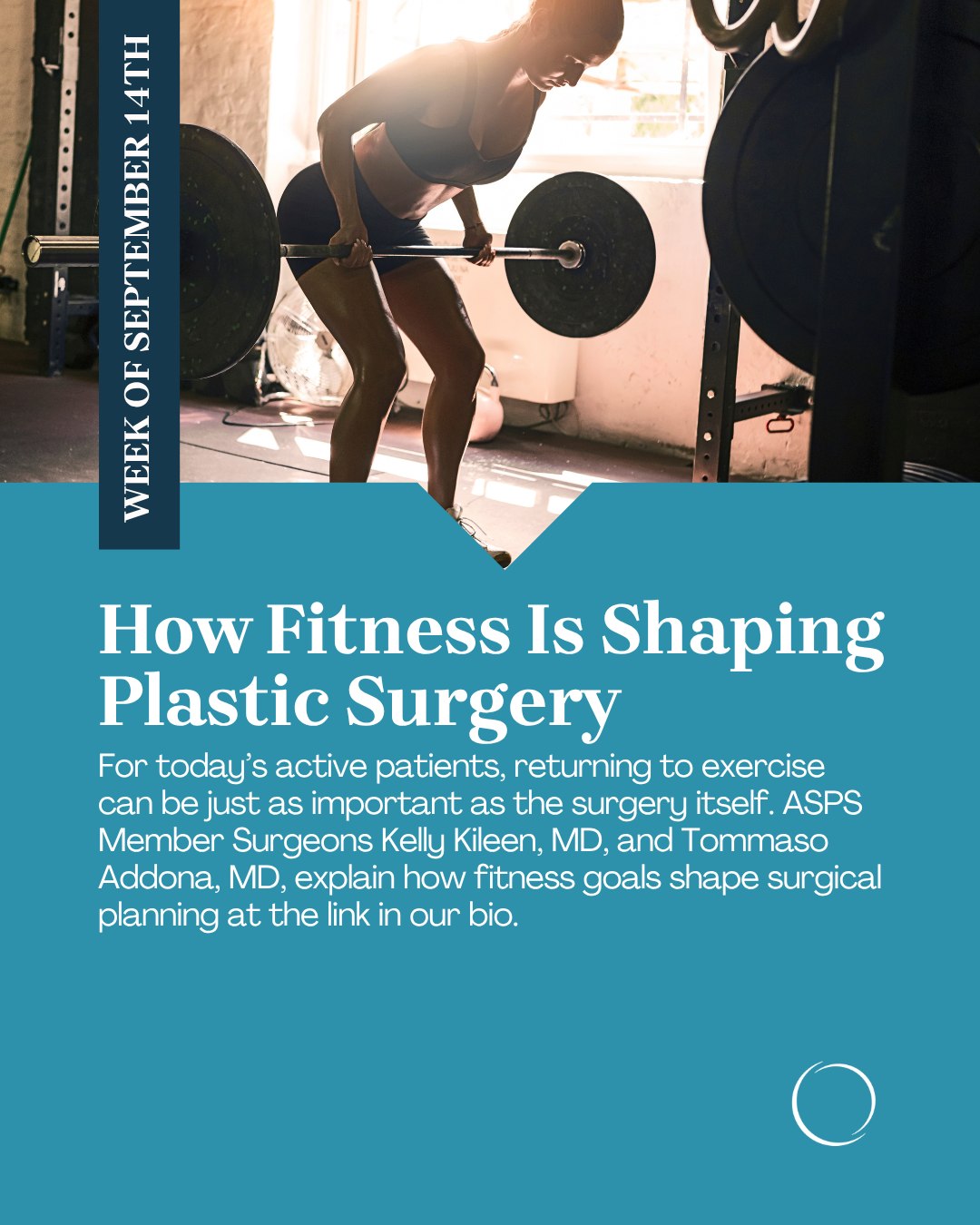
A barbell loaded with weight plates and a pair of hands gripping it mid lift is not the usual image associated with a surgical recovery conversation. But for many patients today, getting back under that bar, or back on a run, or back into a regular training routine, is exactly the outcome they care about most. Fitness is no longer separate from the surgical plan. It is shaping it from the very first consultation.
ASPS Member Surgeons Kelly Kileen, MD, and Tommaso Addona, MD, are speaking to that shift directly this week, breaking down how fitness goals now factor into surgical decisions long before anyone sets foot in an operating room. Patients are arriving with specific training habits, specific movement patterns, and specific timelines for returning to the activities that matter to them, and those details change the conversation considerably.
An active patient is not a passive variable in surgical planning. Someone who lifts heavy, runs distance, or trains consistently has different muscle tone, different healing demands, and different expectations for what recovery should look like. Surgeons factor all of that in when discussing technique, incision placement, and timeline, because the goal is not just a result that looks good. It is a result that holds up under real physical use.
That is part of why the fitness conversation happens early rather than as an afterthought. Knowing that a patient wants to return to weightlifting, or competitive training, or simply a daily gym habit, gives a surgeon information that affects real decisions. It is not about discouraging activity. It is about building a plan that accounts for it honestly from the start, rather than treating movement as something to figure out later.
For many patients, the surgery itself is only half the story. The other half is the return to normal life, and for an active person, normal life includes training. Being told when it is safe to lift again, when to reintroduce cardio, or when full range of motion should be expected is often just as important to a patient as the surgical result itself, because it defines when life actually feels back to normal.
This is why timelines matter so much in these conversations. A generic recovery estimate does not serve someone whose daily routine includes structured exercise. Specific guidance, tailored to the procedure and to the patient's own activity level, gives people something concrete to plan around instead of guessing when they can safely push themselves again.
The questions patients bring into consultations reflect this shift clearly. Fitness goals are being discussed alongside surgical goals, not after them. That is a meaningful change in how these conversations happen, and it reflects a broader pattern of patients who see their bodies as functional first, appearance oriented second, and who want their surgical team to understand both.
This week's roundup also covers post pregnancy procedure safety and the realities of surgical scarring, two more areas where patients are asking sharper, more informed questions than ever. Across all three topics, the throughline is the same: people want real information before they make decisions about their own bodies, not vague reassurance. The full breakdown from Dr. Kileen and Dr. Addona is linked in our bio.
Draft story for plasticsurgery.org · Postpartum Care
Before restarting any treatment after having a baby, here is what deserves patience and what your body may be ready for.
A new mother holds her baby's feet against her own bare stomach, the two bodies pressed together in the quiet, unglamorous middle of early postpartum life. It is a fitting image for the question we get asked constantly this time of year: when is it okay to think about your own skin, your own body, your own routine again, without rushing something your body is not ready for.
The honest answer is that postpartum recovery does not run on a single timeline. Every delivery is different, every body heals differently, and factors like breastfeeding, healing from a cesarean, and simple exhaustion all change what is appropriate and when. That is exactly why we do not hand out a universal checklist and why we always point new mothers toward a real conversation with an ASPS Member Surgeon first.
Self care after having a baby is not indulgent, it is reasonable. But the instinct to jump straight back into whatever routine existed before pregnancy can outpace what the body has actually recovered from. Skin, muscle, and hormone levels are all in transition, and some treatments interact with that transition in ways that are worth understanding before scheduling anything.
Anything involving significant downtime, anesthesia, or major changes to the abdominal area generally needs more healing time, particularly if there was a cesarean delivery. Hormones are also still shifting in the months after birth, which can affect how skin responds to more intensive treatments. This is not about fear, it is about sequencing: giving the body room to stabilize before introducing something that asks more of it.
Breastfeeding adds another layer to the timeline. Certain treatments and products are better postponed while nursing, simply because there is less established data on how they interact with milk production or transfer. It is a conversation worth having directly with a surgeon rather than guessing, since the right answer depends on the specific treatment and the specific person asking about it.
On the other end of the spectrum, some lighter forms of self care are often reasonable earlier in recovery, particularly things focused on gentle skin support rather than dramatic change. The key word is gentle. Postpartum skin has been through a lot, and the goal in these early months is usually maintenance and comfort, not transformation, until the body has had proper time to settle.
What ties all of this together is that there is no one size fits all postpartum plan. What is appropriate for one new mother at six weeks may not be appropriate for another until several months later, and that difference is normal, not a setback. The only real shortcut here is asking the right person the right question before making a decision.
That is why we keep saying it plainly: talk to an ASPS Member Surgeon before restarting any aesthetic routine after having a baby. Save the information, come back to it when you are ready, and let the timeline be shaped by your own recovery rather than a calendar. The glow will keep. Right now, healing comes first.
Draft story for plasticsurgery.org · 2025 trends
New annual data breaks down which procedures actually trended with each group last year.
The 2025 plastic surgery data is in, and the more interesting question is not how many procedures happened but who chose what. Every year the numbers separate cleanly by group, and those differences say something practical about how women and men are approaching cosmetic surgery right now. We pulled the full report to look at the split, and the pattern is worth walking through rather than skimming past.
The report breaks results out by gender, which lets patterns emerge instead of getting flattened into one general trend line. Looking at women and men side by side does more than satisfy curiosity. It shows how differently two groups can approach the same broad category of procedures, and it gives anyone considering surgery a clearer sense of what their peers are actually choosing this year.
Numbers alone do not tell a story until they are compared against something. Seeing which procedures led for women versus which led for men turns a flat statistic into a useful reference point. It also reflects how goals differ. Some patients are focused on contouring, others on facial balance, others on reversing specific changes over time, and the annual data is really a snapshot of thousands of individual decisions.
This is also why we treat the full ASPS report as something worth sharing every year rather than a one time headline. Trends shift gradually, not dramatically, so a year over year view matters more than any single statistic in isolation. Watching how the top procedures for each group move, or stay steady, tells us more about lasting patient priorities than any single data point could on its own.
For anyone actually weighing a procedure, this kind of breakdown is more useful than general buzz. Knowing what is common among people who share your goals, rather than the population as a whole, helps set realistic expectations. It also reframes the decision. A procedure trending within one group is not a trend to follow blindly, but a sign of what a lot of people with similar priorities are currently choosing.
The report itself is thorough, and reducing it to a single swipe through the top procedures for women and men is meant as an entry point, not the whole picture. There is more nuance sitting inside the full statistics, including how these numbers shift across age groups and regions, which is part of why we keep pointing people back to the complete document rather than just the headline figures.
We built this around the actual 2025 ASPS Plastic Surgery Statistics Report, not a general impression of the year. That distinction matters because plastic surgery data changes annually, and last year's assumptions do not always hold. Looking at real numbers, split by group, gives a much steadier starting point for anyone trying to understand where cosmetic procedures actually stand right now rather than where people assume they stand.
The full breakdown, including the specific procedures that led for each group, is available through the report linked in our bio. It is worth spending a few minutes with the complete numbers rather than just the summary, especially if a specific procedure is already on your mind. The data does not decide anything for you, but it gives you a clearer, more current picture to decide with.
Keep reading