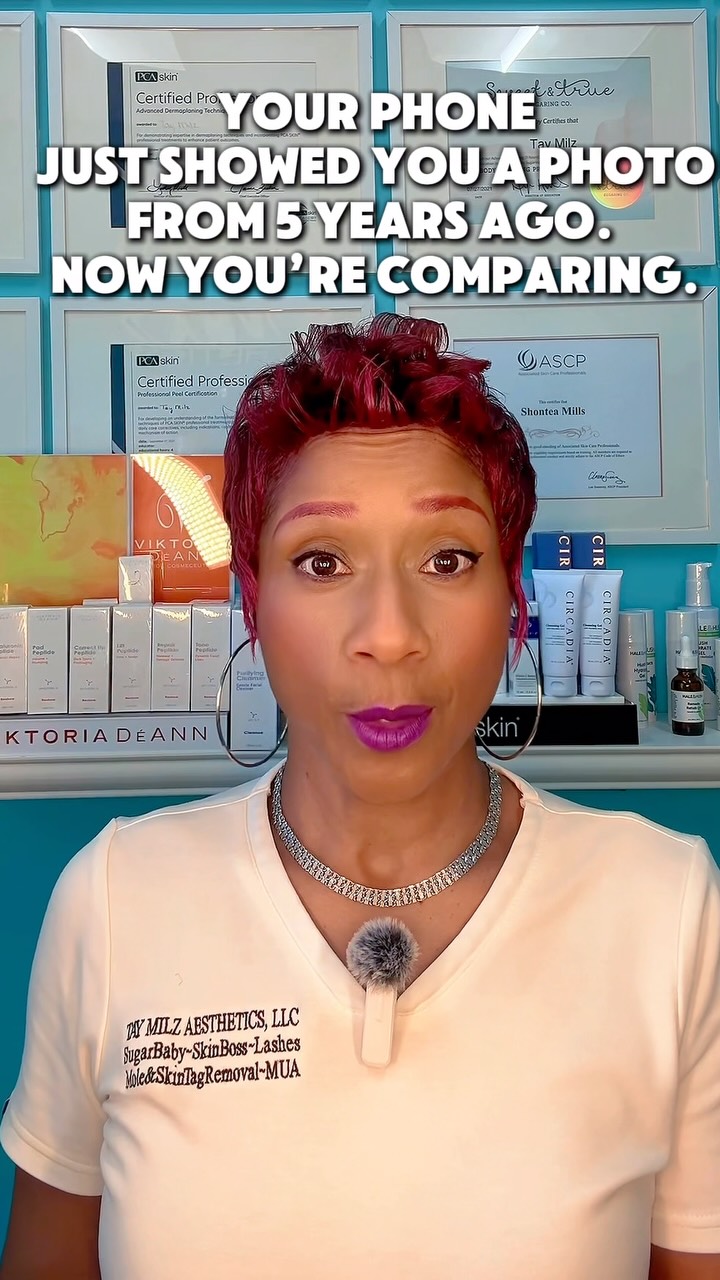
Stop comparing your skin to a five year old photo
A memory pops up on your phone and suddenly today's skin feels like a problem. Here is why that comparison never tells the truth.
TAY MILZ AESTHETICS STAFFTurn your social into search
We turn your posts into editorial stories that bring new search traffic to taymilzaesthetics.com. Three of yours will be on this page.
Book a demo
taymilzaesthetics Sis, there is a difference between noticing change and deciding something went wrong. But the second our phone shows us a memory from five years ago, it is so easy to start measuring today against yesterday. Your skin doesn’t need you chasing who you used to be. It needs you paying attention to the woman you are right now. What are you noticing? What matters to you now? What kind of care makes sense for the skin you’re living in today? That is a completely different conversation than trying to get back to an old photograph. Taking care of yourself now doesn’t require comparing your skin to what it looked like five years ago. It simply means meeting yourself exactly where you are. and choosing your care from there. Save this for the next time an old picture has you questioning the woman in the mirror. 🩵 Glow Guided. Never Guessed.
A memory pops up on your phone and suddenly today's skin feels like a problem. Here is why that comparison never tells the truth.
TAY MILZ AESTHETICS STAFFHow it works
Same as today. Nothing changes on Instagram.
We turn your post into a full story in your voice within the hour.
One click publishes it to taymilzaesthetics.com. Nothing goes live without you.
Your stories
Nothing was published anywhere. You decide that. Every word will come from your own posts, your own photos and your own treatments.
Skin Perspective · From your post
A memory pops up on your phone and suddenly today's skin feels like a problem. Here is why that comparison never tells the truth.
“Sis, there is a difference between noticing change and deciding something went wrong. But the second our phone shows us a memory from five years ago, it is so easy to start measuring today against yesterday. Your skin doesn’t need you chasing who you used to be. It needs you paying attention to the woman you are right now. What are you noticing? What matters to you now? What kind of care makes sense for the skin you’re living in today? That is a completely different conversation than trying to get back to an old photograph. Taking care of yourself now doesn’t require comparing your skin to what it looked like five years ago. It simply means meeting yourself exactly where you are. and choosing your care from there. Save this for the next time an old picture has you questioning the woman in the mirror. 🩵 Glow Guided. Never Guessed.”
Skincare Strategy · From your post
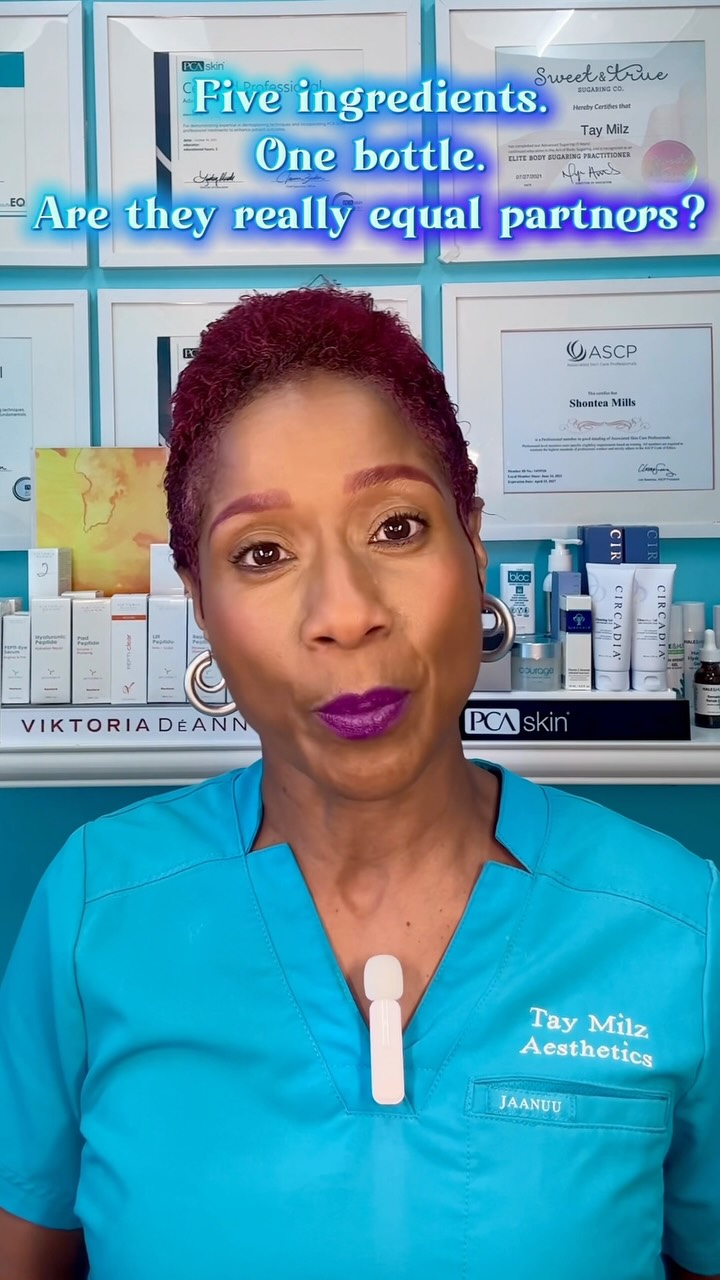
A closer look at why a long list of benefits on a label is not the same as a routine built for your skin.
“Just because a product claims to do five things doesn’t mean your skin needs all five. That’s where skincare can get noisy. We see claims like brightening, smoothing, hydrating, firming, and resurfacing all wrapped around one bottle, and a long list of benefits can make a product sound impressive. But I’m less interested in how many things a product claims to do. and more interested in what job it needs to have in your routine. Because a long list of claims still doesn’t answer the most important question. Does this make sense for your skin and the routine you’re building? That’s the kind of question I want you asking before another bottle earns space on your bathroom counter. Comment GLOW and I’ll make sure you’re first to know when the Glow Profile opens. 🩵 Glow Guided. Never Guessed.”

Skin Care · From your post
A closer look at why melanin rich skin deserves more specific answers than a label on a bottle can give.
““For all skin types” sounds inclusive. But it still leaves a question unanswered. What does that mean for your skin? Because a broad label can tell you how a product is being marketed. It can’t make the entire skincare decision for you. That’s why I want you looking beyond the front of the bottle and asking better questions about what actually belongs in your routine. Not because your skin is difficult. Because specific matters. And grown women with melanin rich skin deserve skincare conversations that leave room for our skin, our concerns, and our context. Know a woman who’s tired of one size fits all skincare advice? Send this to her. 🩵 Glow Guided. Never Guessed.”
One social post becomes another searchable entry point to Tay Milz Aesthetics.
Our own magazine. Clicks and citations from Google Search Console, as of September 15, 2026.
Draft story for taymilzaesthetics.com · Skin Perspective
A memory pops up on your phone and suddenly today's skin feels like a problem. Here is why that comparison never tells the truth.
It happens in a second. Your phone surfaces a photo from five years ago, and before you even register what you are looking at, you are measuring your current face against it. That is not skincare. That is a snapshot doing something a snapshot was never built to do: hold you accountable to a version of yourself that no longer exists in that context.
There is a real difference between noticing a change and deciding that change means something went wrong. Noticing is useful. It tells you something is different. Deciding it is a failure is a story you are adding on top, usually without evidence, and usually while standing in bad lighting comparing your bare face to a filtered, posed, five year old frame.
Your skin does not know what year it is. It only knows what you are doing for it right now, today, in the life you are actually living. Chasing an old photograph means chasing a moment, not a practice. The woman in that picture was dealing with her own version of stress, sleep, sun, and time. You are dealing with yours.
So instead of asking whether you look like you did five years ago, try asking what you are actually noticing right now. Is it texture. Is it tone. Is it a dullness that shows up by afternoon. Those are specific, current, workable observations. They point toward a plan. A vague feeling of used to look better points toward nothing except discouragement.
From there, ask what matters to you now. Priorities shift. What you wanted your skin to do at twenty five is not necessarily what you want it to do today, and that is not a loss, it is just a different set of goals attached to a different season of your life. Naming the goal clearly is what makes the care that follows make sense.
That is the real starting point for any conversation about care: not the old photo, but the skin you are living in this week. What kind of attention does it need. What has changed enough to warrant a new approach. What has stayed the same and still works. Those answers only come from paying attention now, not from measuring backward.
Save this for the next time an old picture catches you off guard and has you second guessing the woman in the mirror. Taking care of yourself was never about getting back to a photograph. It is about meeting yourself exactly where you are and choosing care from there. Glow Guided, never guessed, starts with looking at today's skin honestly, not yesterday's picture.
Draft story for taymilzaesthetics.com · Skincare Strategy
A closer look at why a long list of benefits on a label is not the same as a routine built for your skin.
A bottle that promises to brighten, smooth, hydrate, firm, and resurface sounds like it has done the hard work for you. Five jobs, one purchase, done. But that framing skips the actual question, which has nothing to do with how many things a product claims and everything to do with whether your skin needs those five things at all, right now, in that order.
This is the noise we talk about constantly in our Culver City studio. Claims accumulate on packaging because claims sell. Brightening sounds appealing. Firming sounds appealing. Resurfacing sounds appealing. Stack them together and the product feels efficient, like a shortcut through five separate purchases. The label is not lying. It is just answering a question nobody asked in the first place.
The question worth asking is narrower and less exciting to market: what job does this product need to have in your routine. Not what it is capable of in a lab setting, but what role it is actually filling on your counter, next to whatever else you are already using, layered in whatever order you already follow, for whatever your skin is doing this month.
A five in one product cannot tell you if you are already resurfacing through another step and do not need a second one competing for the same job. It cannot tell you if your skin is dealing with sensitivity that makes firming actives premature. It cannot tell you if hydration is already handled and the brightening claim is the only line on the label that matters to you.
That is not a flaw in the product. It is simply outside what a label was ever built to do. The label describes the bottle. It does not describe your skin, your history, your current routine, or what you are trying to solve this season versus what you were trying to solve last year. Only a real look at your skin can supply that context.
We would rather see someone build a routine with intention than collect bottles because each one sounded comprehensive. A long ingredient list still leaves the most important question unanswered, which is whether this particular product belongs in your particular routine. That is the filter we want people using before another bottle earns permanent space on the counter.
This is the thinking behind the Glow Profile, a way of matching what your skin actually needs instead of what a label claims it can do. If that approach makes sense to you, comment GLOW and we will make sure you hear the moment it opens. Glow guided, never guessed, is not a tagline here. It is the standard we hold every recommendation to.
Draft story for taymilzaesthetics.com · Skin Care
A closer look at why melanin rich skin deserves more specific answers than a label on a bottle can give.
For all skin types is one of the most common phrases in skincare, printed across bottles to signal that a product will work broadly and without exception. It sounds inclusive. It sounds like it has already done the thinking for you. But a label is marketing language, not a diagnosis, and it was never built to answer the one question that actually matters, which is what does this mean for your skin specifically.
That gap is exactly what we want women to start noticing. A broad claim can tell you how a product is positioned on a shelf. It cannot account for your tone, your history, your sensitivities, or the way your skin actually responds day to day. Reading past the front of the bottle is not about distrust. It is about asking better questions before something becomes part of your routine.
There is a difference between skin that needs more consideration and skin that gets labeled as complicated. We want to be clear about which one is true. Melanin rich skin is not harder to care for. It simply carries its own set of concerns and reactions that deserve to be named directly instead of folded into a catch all category built around a general average.
Grown women with melanin rich skin have heard one size fits all advice for years, and much of it was never built with their skin in mind to begin with. That history is part of why the question deserves more attention now. Being specific about skin is not extra effort. It is the missing piece that broad labeling always skipped over in the first place.
So instead of asking whether a product is for all skin types, we would rather start with what your skin is actually dealing with. Is it reactive. Is it prone to dark marks. Does it hold onto redness longer than it should. Those answers point toward real decisions, while a broad label mostly just points toward a wider audience a product hopes to reach.
This is the thinking behind Glow Guided, Never Guessed. Guidance means starting with your skin and building outward from there, not starting with a product and hoping it fits. Guessing means trusting a phrase on packaging to do work it was never designed to do. The difference shows up over time, in whether your routine is actually built around you or simply marketed toward you.
If you know a woman who is tired of hearing the same general advice repeated back to her, this is worth sharing with her directly. Skincare conversations should leave room for her tone, her concerns, and her context, not shrink them down to fit a label built for everyone and no one at once. That is the standard we are asking women to expect going forward.
Keep reading